
Microfinance institutions, NBFCs, lending companies, and financial organisations are handling more borrowers, loan accounts, repayments, collections, and compliance requirements than ever before. Managing these operations manually or through disconnected systems can create delays, errors, data gaps, and poor customer experiences.
This is where microfinance software becomes important.
The right technology can help organisations manage the complete lending lifecycle — from customer onboarding and loan applications to verification, disbursement, repayment, collections, reporting, and portfolio management.
For institutions looking for the best microfinance software, choosing the right platform requires more than comparing features. The software should match the organisation’s lending model, operational requirements, scalability, security standards, and future growth plans.
This guide explains what microfinance software is, its key features, benefits, and how businesses can choose the right microfinance loan management software for their operations.
What is Microfinance Software?
Microfinance software is a specialised digital platform designed to manage lending and financial operations for microfinance institutions, NBFCs, credit societies, lending companies, and other financial organisations.
- A comprehensive system can centralise activities such as:
- Customer registration and onboarding
- Loan applications
- KYC and document management
- Credit assessment
- Loan approval
- Loan disbursement
- Interest calculation
- EMI and repayment tracking
- Collection management
- Customer communication
- Portfolio monitoring
- Reports and analytics
- Employee and branch management
Instead of maintaining information across spreadsheets, paper records, and multiple applications, organisations can manage their lending operations through a centralised platform.
The growing adoption of microfinance software in India is also driven by the increasing need for faster lending processes, better financial visibility, improved customer service, and efficient compliance management.
Why is Microfinance Software Important for Financial Institutions?
Microfinance operations involve large volumes of transactions and customer data. Even a small process error can affect collections, accounting, customer records, or reporting.
Traditional manual processes often create problems such as:
- Duplicate customer records
- Delayed loan processing
- Incorrect calculations
- Difficult repayment tracking
- Limited collection visibility
- Time consuming reporting
- Poor document management
- Lack of real time business insights
A reliable microfinance loan management software solution can automate many repetitive activities while giving management better control over operations.
It can also connect different departments and branches through a single digital environment.
For growing organisations, this means employees can spend less time managing paperwork and more time serving customers and improving lending operations.
Key Features of the Best Microfinance Software
Not every lending platform offers the same capabilities. When comparing the best microfinance software, businesses should look for features that support the entire lending lifecycle.
1. Customer Management
A centralised customer management system helps institutions maintain complete borrower profiles.
Customer information, contact details, KYC documents, loan history, repayment records, and other relevant information can be organised in one place.
This makes it easier for employees to access accurate information whenever required.
2. Loan Application Management
A strong loan application module can streamline the journey from application to approval.
Employees can record applications, collect documents, track application status, and move eligible applications through different approval stages.
This reduces unnecessary paperwork and improves processing speed.
3. KYC and Document Management
KYC is an important part of financial operations.
Microfinance software can help organisations organise customer documentation and verification information digitally. Depending on the system and integrations available, organisations may also connect relevant verification and digital identity services.
A structured document management process makes records easier to access and maintain.
4. Loan Processing and Approval
Loan processing involves multiple steps, including eligibility checks, verification, approval, documentation, and disbursement.
A comprehensive system can define workflows and approval levels according to the organisation’s requirements.
This helps reduce manual intervention and provides better visibility into pending applications.
5. Loan Disbursement
After approval, the software can help manage disbursement details and update the customer’s loan account.
Automated workflows can reduce processing delays and help ensure that loan records remain consistent across the system.
6. EMI and Interest Management
Calculating repayments manually can become complicated when an organisation manages thousands of loan accounts.
Microfinance software can automate calculations based on configured loan products, interest rates, repayment schedules, penalties, and other parameters.
This reduces calculation errors and makes repayment schedules easier to manage.
7. Collection Management
Collections are one of the most important areas of microfinance operations.
A good system should help teams monitor:
- Upcoming repayments
- Overdue accounts
- Collection performance
- Field collection activities
- Outstanding amounts
- Customer repayment history
Better collection visibility can help management identify problem accounts and take timely action.
8. Reporting and Analytics
Management needs accurate information to make informed business decisions.
The best microfinance software should provide useful reports covering areas such as loan disbursement, collections, outstanding balances, overdue accounts, branch performance, and portfolio activity.
Real time dashboards can make this information easier to understand.
Benefits of Using Microfinance Software in India
The adoption of microfinance software in India offers several operational advantages.
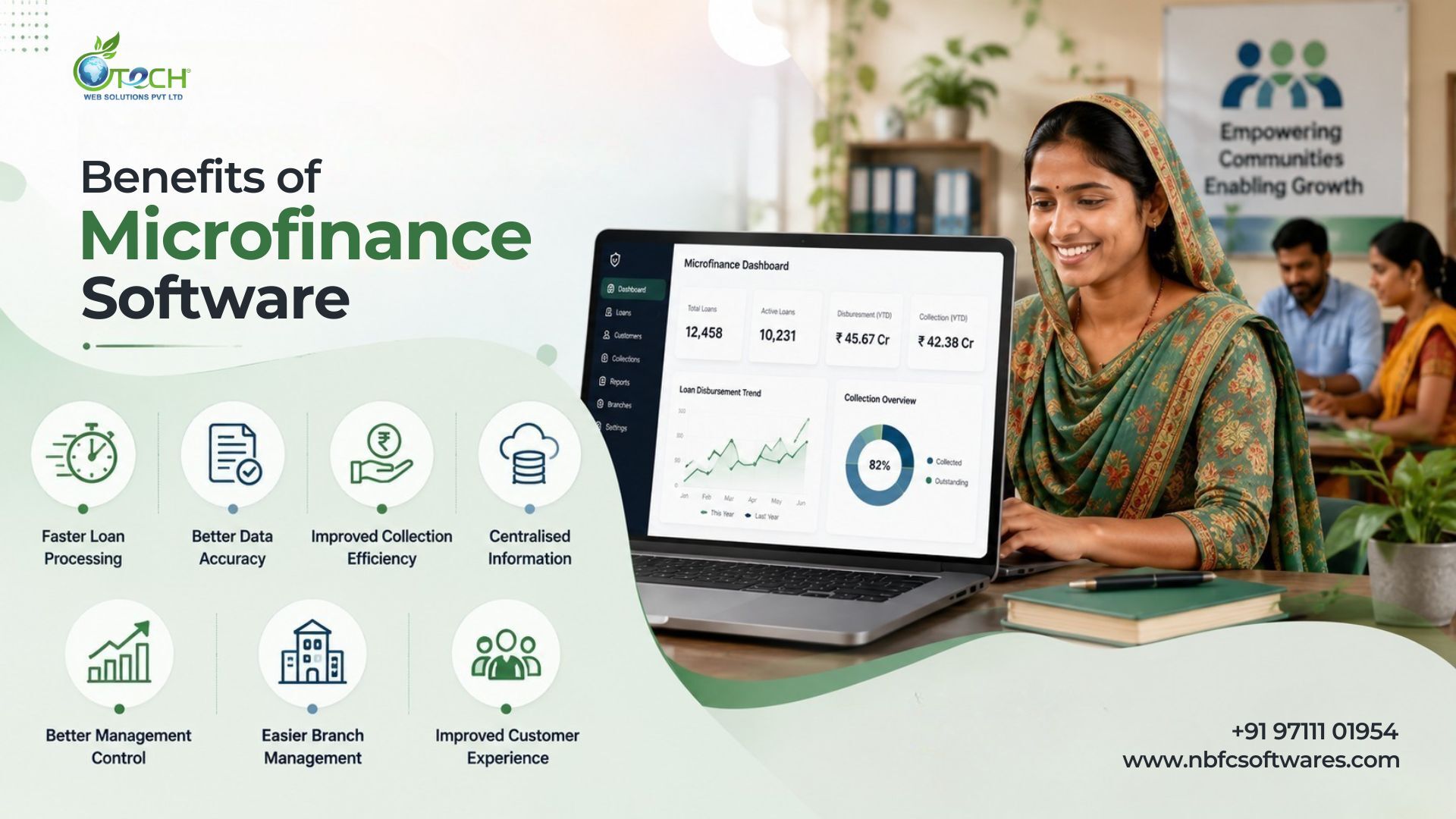
Faster Loan Processing
Automated workflows can reduce repetitive manual activities and help employees process applications more efficiently.
Better Data Accuracy
Centralised records and automated calculations can reduce common data-entry and calculation errors.
Improved Collection Efficiency
Collection teams can access repayment information and outstanding account details more easily.
Centralised Information
Customer, loan, repayment, collection, and operational data can be managed through a single platform.
Better Management Control
Business owners and senior management can monitor lending and collection activities through dashboards and reports.
Easier Branch Management
Organisations operating across multiple branches can maintain better visibility over branch level operations and performance.
Improved Customer Experience
Faster processing, accurate information, and better communication can create a smoother borrowing experience.
Cloud Based Loan Management Software vs Traditional Systems
Many financial organisations are moving from locally installed systems to Cloud Based Loan Management Software.
Traditional software may require local infrastructure, manual updates, and dedicated maintenance. Cloud based platforms can provide access to business information through secure internet enabled environments.
The benefits can include:
- Remote accessibility
- Centralised data
- Easier updates
- Scalable infrastructure
- Reduced dependency on local servers
- Multi branch accessibility
- Centralised reporting
For organisations with distributed teams or multiple branches, cloud technology can make daily operations more flexible.
However, businesses should carefully evaluate security, data protection, access controls, backups, system reliability, and vendor support before selecting a cloud solution.
Microfinance Software and Lending Management Software Services
Modern lending organisations need more than basic loan accounting.
They require technology that supports the complete lending journey.
This is where Lending Management Software Services can become valuable. A comprehensive lending platform can bring customer onboarding, loan processing, repayment, collection, reporting, and portfolio management together.
Depending on the organisation’s requirements, the system may also integrate with third party services for verification, credit information, payments, communication, and other financial processes.
The goal is simple: create one connected workflow instead of managing each lending activity separately.
Role of a Fintech Software Company in India
The technology partner behind the software is as important as the software itself.
A reliable Fintech Software Company India can understand the specific requirements of financial institutions and develop solutions around lending workflows.
When evaluating technology providers, businesses should consider:
- Experience in financial technology
- Microfinance industry expertise
- Product flexibility
- Integration capabilities
- Data security
- Cloud infrastructure
- Customer support
- Software scalability
- Regular product updates
- Implementation and training
A provider with experience in financial technology can better understand the operational challenges faced by lenders.
This can make implementation smoother and reduce the risk of choosing a system that looks good on paper but does not fit the organisation’s actual workflow.
How to Choose the Best Microfinance Software
Choosing the best microfinance software should be based on business requirements rather than simply selecting the platform with the longest feature list.
Define Your Lending Requirements
Start by identifying the types of loans your organisation offers, customer segments, repayment models, branches, employees, and collection processes.
Evaluate the Complete Loan Lifecycle
Check whether the platform supports the entire journey from customer onboarding to loan closure.
A system that only handles loan accounting may not be enough for a growing lending business.
Check Scalability
Your software should be able to support increasing customers, employees, branches, and loan accounts.
Scalability is particularly important for organisations planning rapid expansion.
Review Security
Financial data is highly important. Ask vendors about user permissions, authentication, backups, encryption, hosting infrastructure, audit trails, and data protection practices.
Check Integration Options
Modern lending businesses often use multiple digital services.
Check whether the software can integrate with relevant KYC, credit bureau, payment, banking, accounting, SMS, email, and other systems required by your organisation.
Consider User Experience
A technically powerful platform can still be difficult to use.
The interface should be simple enough for branch employees, collection teams, managers, and administrators to operate efficiently.
Evaluate Support
Implementation is only the beginning.
Look for a vendor that provides proper onboarding, training, technical support, troubleshooting, and regular system improvements.
Microfinance Software Companies in India: What Should You Compare?
There are many microfinance software companies in India, and their products can differ considerably.
Instead of choosing a provider solely on price, compare the following factors:
| Factor | What to Check |
| Features | Does it cover your complete lending process? |
| Scalability | Can it support future growth? |
| Security | Are appropriate security controls available? |
| Integration | Can it connect with your existing systems? |
| Cloud Access | Is cloud deployment available if required? |
| Reporting | Are real time reports and dashboards available? |
| Support | What implementation and technical support is provided? |
| Customisation | Can workflows be configured for your business? |
| User Management | Can access be controlled by roles and branches? |
| Cost | Does the pricing match your long term requirements? |
A proper comparison can help businesses avoid selecting software that becomes restrictive as their operations grow.
Financial Management Software and Microfinance Operations
Microfinance businesses also need strong financial visibility.
While loan management focuses primarily on lending operations, Financial Management Software can help organisations monitor broader financial activities.
When financial and lending systems work together, management can gain a clearer view of business performance.
Useful areas may include:
- Income and expenses
- Loan related financial activity
- Outstanding amounts
- Branch performance
- Cash flow visibility
- Financial reporting
- Operational expenses
Integrating financial information with lending data can help management make better decisions based on a more complete view of the organisation.

Why Cloud Technology Is Becoming Important in Microfinance
The lending industry is becoming increasingly digital.
Customers expect faster services, employees need instant access to information, and management requires real time visibility. Cloud based systems can support these requirements by allowing authorised users to access the platform from different locations. For growing microfinance institutions, this can be particularly useful when operations are spread across several branches or geographical regions.
A cloud platform can also simplify software updates and centralised data management. However, cloud adoption should always be combined with strong security policies, appropriate access controls, regular backups, and reliable infrastructure.
Common Mistakes to Avoid When Selecting Microfinance Software
Choosing software without proper evaluation can create long term problems.
Choosing Only Based on Price
The cheapest system may not provide the features, scalability, or support your organisation needs.
Ignoring Future Growth
Software should be evaluated based on where your business is going, not only where it is today.
Overlooking Integrations
Disconnected systems can create unnecessary manual work.
Not Testing the Software
Always request a demonstration and, where possible, test the workflows with actual business scenarios.
Ignoring Support
A software provider should be able to support implementation, training, troubleshooting, and future requirements.
Focusing Only on Features
A long feature list does not automatically mean the software is right for your organisation.
Ease of use, reliability, security, scalability, and support are equally important.
The Future of Microfinance Software in India
The future of microfinance software in India will increasingly focus on automation, digital lending, real time analytics, mobile accessibility, artificial intelligence, and connected financial ecosystems.
Technology can help lenders analyse large amounts of information, identify operational patterns, automate repetitive tasks, and improve customer interactions.
Mobile first lending will also remain important as more customers and field employees rely on smartphones for financial activities.
As the industry evolves, microfinance institutions will need platforms that can adapt to changing customer expectations and business requirements.
The focus will move from simply managing loans to creating a complete digital lending ecosystem.
Final Thoughts
The right microfinance loan management software can transform how a lending organisation manages customers, loans, repayments, collections, branches, and financial information.
For institutions searching for the best microfinance software, the decision should be based on functionality, scalability, security, integrations, usability, support, and long term business requirements.
Whether you are a microfinance institution, NBFC, credit society, or growing lending business, investing in the right technology can help reduce manual work, improve operational control, and create a more efficient lending process.
As the financial sector continues to become more digital, working with experienced microfinance software companies in India and choosing a scalable platform can give lending businesses the technology foundation they need for sustainable growth.