
India’s lending industry has changed shape faster in the last five years than in the previous twenty. Digital KYC, instant credit bureau pulls, UPI-linked collections, co-lending partnerships the rules of the game keep shifting, and any financial institution still running its loan book through spreadsheets and disconnected tools is quietly falling behind. If you’re a bank, an NBFC, or a fintech lender trying to work out what actually separates a good loan management software from a mediocre one, this guide breaks it down in plain terms.
Why Loan Management Software Actually Matters
It’s tempting to treat loan management software as just another line item in the IT budget. In reality, it functions closer to the nervous system of a lending business. Every loan that originates, every EMI that gets collected, every account that slips into delinquency all of it runs through this one layer of the operation.
When that layer is built well, a few things happen almost on their own.
Manual work disappears. Loan officers stop re-entering the same borrower details across three different systems. Underwriting decisions that used to take two or three days can now happen within hours, because the software pulls credit bureau reports, income documents, and risk scores into a single screen instead of forcing someone to chase each piece down separately.
Risk gets caught earlier. A properly built system flags irregular repayment behaviour, ageing receivables, and compliance gaps long before they turn into write-offs. That’s not a minor detail in a market where NPA management is a permanent fixture on every NBFC’s board agenda.
Borrowers notice the difference. Nobody enjoys filling out the same form twice or waiting a week to hear back on an application. Good loan management software compresses that timeline considerably, and customers remember it. For NBFCs competing against larger, better-capitalised banks, that kind of word-of-mouth reputation is worth more than most marketing budgets.
What Separates Good Software From Great Software
Not every loan management platform on the market is built equally, and the ones that look impressive in a sales demo don’t always hold up once they’re handling thousands of live accounts. Here’s what genuinely matters when evaluating your options.
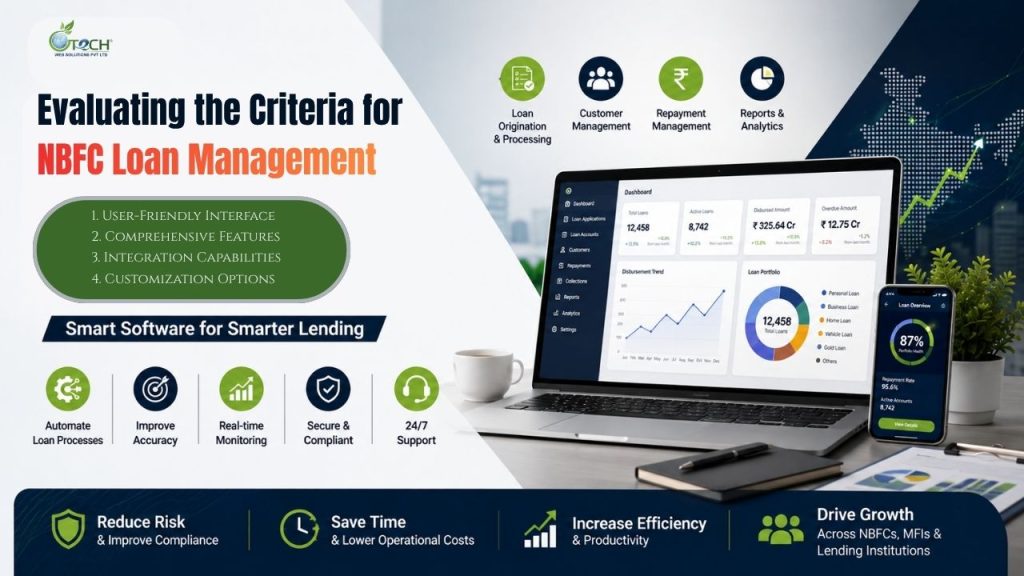
1. An Interface People Will Actually Use
Software is only as useful as the willingness of your team to open it every morning. If a platform needs a week long training programme before a new loan officer can use it comfortably, that’s a red flag, not a feature. The best loan management software in India is built so that both a fresh recruit and a fifteen-year veteran of the credit team can find what they need without hunting through five layers of menus.
2. Genuinely Comprehensive Features
A lending platform that only handles origination but falls apart at servicing, or that manages collections but has no reporting depth, will eventually force your team back into Excel which defeats the entire purpose. Look for software that covers the full loan lifecycle: origination, disbursement, servicing, collections, and reporting, all under one roof, with the flexibility to scale as your loan book grows from hundreds of accounts to hundreds of thousands.
3. Integration That Doesn’t Require a Miracle
Your loan management system doesn’t operate in isolation. It needs to talk to your accounting software, your CRM, your credit bureau connections, payment gateways, and often a handful of regulatory reporting tools as well. Software that integrates cleanly with this ecosystem saves your IT team from building and maintaining a pile of custom workarounds workarounds that tend to break at the worst possible moment, usually during a compliance audit.
4. Real Customization, Not Just a Colour Palette
Every NBFC, housing finance company, and microfinance institution operates a little differently. Loan products differ, approval workflows differ, and risk appetite differs. A platform that only lets you change the logo and call it “customization” isn’t solving the actual problem. What you want is software that lets you configure workflows, approval hierarchies, and product rules to match how your institution actually operates not the other way around.
5. Compliance Built In, Not Bolted On
RBI guidelines for NBFCs shift periodically, and staying compliant isn’t optional. Software that treats regulatory reporting as an afterthought will leave your compliance team scrambling every time a circular is issued. The stronger platforms build compliance checks and audit trails directly into the workflow, so reporting is a byproduct of daily operations rather than a separate, dreaded monthly task.
6. Reporting and Analytics You Can Actually Act On
Data is only valuable if someone can read it quickly and make a decision from it. Dashboards that bury useful numbers under decorative charts don’t help anyone. Good loan management software gives management real-time visibility into portfolio health, collection efficiency, and branch-level performance — the kind of numbers that inform decisions rather than just decorating a quarterly review deck.
Where NBFC Software Fits Into This Picture
After going through this criteria against what’s actually available in the Indian market, NBFC Softwares stands out as one of the strongest options for financial institutions serious about modernising their loan operations. A few things about their approach are worth calling out specifically.
They’ve built around actual lending workflows, not generic templates. The platform reflects an understanding of how Indian NBFCs and lenders operate day to day, rather than a one-size-fits-all system adapted loosely from a foreign template.
Technology that’s genuinely current. NBFC Software uses AI and machine learning inside its decisioning tools, which means underwriting isn’t just faster it’s also more consistent, reducing the kind of variability that creeps in when different loan officers apply slightly different judgment calls to similar applications.
Security treated as a foundation, not an add-on. Financial data is about as sensitive as data gets, and NBFC Software builds its infrastructure around that reality, with safeguards designed to protect borrower and institutional information at every layer of the system.
Built to grow with you. A platform that works fine for 5,000 accounts but buckles at 50,000 isn’t really scalable — it’s just temporarily adequate. NBFC Softwares is architected to handle growth without the performance dips or awkward re-platforming projects that plague less mature systems.
Support that responds like a partner, not a ticket queue. Software problems during a collections cycle or a regulatory deadline aren’t the moment to discover your vendor’s support team is slow or hard to reach. Clients consistently point to responsive, hands-on support as one of the more underrated advantages of working with NBFC Softwares.
Mistakes to Avoid When Choosing a Platform
A few patterns show up again and again when institutions pick the wrong loan management software:
- Choosing on price alone. The cheapest option often becomes the most expensive one once you factor in the manual workarounds it forces on your team.
- Ignoring scalability. A system that fits today’s loan book but can’t handle next year’s growth means a painful migration down the line.
- Underestimating the compliance angle. Software that isn’t built with Indian regulatory requirements in mind will always be playing catch-up.
- Skipping the trial period. A demo looks polished by design. Actually running your workflows through the system before committing tells you far more than any sales pitch.
Where This Is All Heading
Lending in India is moving toward faster decisioning, deeper use of alternate data for credit scoring, and tighter integration between origination and collections. Cloud-based systems are becoming the default rather than the exception, partly because they let smaller NBFCs access infrastructure that used to be available only to large banks. Institutions that adopt this kind of technology now are positioning themselves for a market that’s only going to move faster.
Conclusion
Choosing loan management software isn’t a decision to rush, and it isn’t one to make on price alone either. It shapes how efficiently your institution operates, how well you manage risk, and ultimately how your borrowers experience working with you. NBFC Software checks the boxes that matter most a user friendly interface, comprehensive lifecycle coverage, real integration capability, meaningful customization, built-in compliance, and support that actually shows up when you need it.
If you’re evaluating options for your institution, it’s worth taking a closer look at what nbfcsoftwares.com has to offer before making a final call.