If you’ve sat through a few vendor demos, you’ve probably noticed that “LOS” and “LMS” get thrown around as if everyone already knows the difference. Some vendors sell them separately. Others bundle them. A few claim one tool does it all.
So before you sign a contract, it’s worth asking a simple question: LOS vs LMS for NBFCs, which one does you actually need?
The short answer is that they solve different problems, and most growing lenders end up needing both. But the how matters. This guide explains what each system does, where they overlap, and how to decide what fits your business without overspending.
The Quick Answer: LOS vs LMS in One Minute
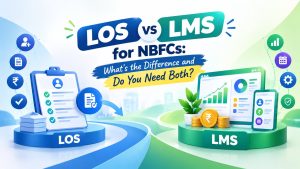
A Loan Origination System (LOS) manages everything that happens before a loan is disbursed: application, KYC, credit checks, underwriting, and approval.
A Loan Management System (LMS) manages everything that happens after disbursement: EMI schedules, repayments, collections, interest accruals, restructuring, and loan closure.
Think of it this way. The LOS gets the customer in the door. The LMS looks after the relationship for the next 12, 24, or 60 months.
What is a Loan Origination System (LOS)?
A loan origination system automates the journey from the first customer enquiry to the final approval decision. It replaces the stacks of paper forms, email chains, and manual checks that slow down traditional lending.
A good LOS typically handles:
- Lead capture and application intake
- Digital KYC (Aadhaar eKYC, CKYC, PAN verification)
- Document collection and verification
- Credit bureau pulls (CIBIL, Experian, Equifax, CRIF High Mark)
- Bank statement and income analysis
- Credit scoring and underwriting rules
- Approval workflows and sanction letters
- eSign and eMandate setup
Why the LOS Matters
The origination stage is where lenders win or lose customers. A borrower who waits three days for a decision on a small-ticket loan will often go elsewhere. A faster, cleaner LOS reduces turnaround time, cuts drop-offs, and keeps your credit policy consistent across every branch and sales agent.
It also protects your portfolio. When underwriting rules sit inside the system instead of in someone’s head, you reduce subjective decisions and, over time, improve asset quality.
What Is a Loan Management System (LMS)?
Once the loan is approved and the money goes out, a different set of challenges begins. That’s where the loan management system takes over.
A solid LMS typically manages:
- Loan account creation and disbursement
- EMI and repayment schedule generation
- Interest calculation and accruals
- Payment tracking and reconciliation
- Collections, reminders, and follow-up workflows
- Penal charges, prepayments, and foreclosures
- Restructuring and rescheduling
- NPA classification and provisioning support
- Customer statements and closure documents
- MIS reports and regulatory filings
Why the LMS Matters
The LMS is the system of record for your loan book. Every rupee disbursed, every instalment received, and every overdue day is tracked here. If your numbers are wrong, your financials, your collections strategy, and your regulatory reporting are all wrong.
For an NBFC, the LMS is often the more critical system over the long run, because the loan stays on your books far longer than the application stays in your pipeline.
LOS vs LMS: Key Differences at a Glance
| Parameter | LOS (Loan Origination System) | LMS (Loan Management System) |
| Stage of lifecycle | Pre-disbursement | Post-disbursement |
| Main purpose | Acquire and approve borrowers | Service, collect, and close loans |
| Core activities | Application, KYC, underwriting, sanction | EMI tracking, collections, accounting, closure |
| Key users | Sales teams, credit analysts, underwriters | Operations, collections, finance, compliance |
| Primary goal | Faster, accurate approvals | Accurate servicing and better recovery |
| Typical metrics | TAT, approval rate, drop-off rate | Collection efficiency, DPD, NPA ratio |
| Data focus | Applicant and credit data | Loan account and repayment data |
If you remember one thing from this table, make it the lifecycle split: LOS = getting the loan, LMS = running the loan.
How an LOS and LMS Work Together
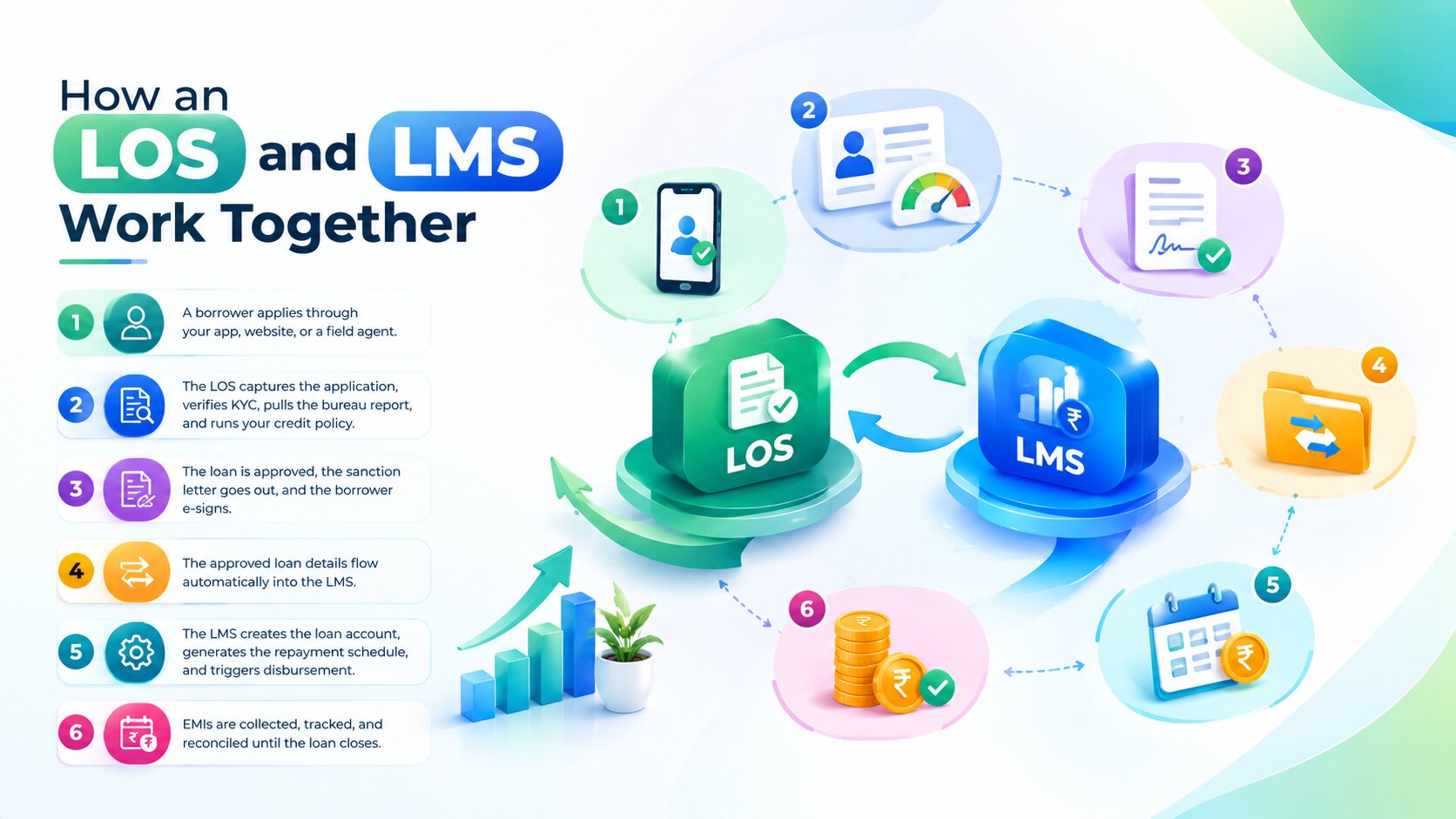
In a well-connected setup, the two systems pass data to each other seamlessly. Here’s what that looks like in practice:
- A borrower applies through your app, website, or a field agent.
- The LOS captures the application, verifies KYC, pulls the bureau report, and runs your credit policy.
- The loan is approved, the sanction letter goes out, and the borrower e-signs.
- The approved loan details flow automatically into the LMS.
- The LMS creates the loan account, generates the repayment schedule, and triggers disbursement.
- EMIs are collected, tracked, and reconciled until the loan closes.
When that handoff works, nobody retypes anything. When it doesn’t, you get a mess: duplicate entries, mismatched figures, and operations team’s manually fixing data at the end of every day.
That handoff is exactly where many NBFCs run into trouble, which brings us to the real question.
Do NBFCs Need Both an LOS and an LMS?
It depends on your size, your product mix, and how you lend. Here are the common scenarios.
Scenario 1: A Very Small or Early-Stage NBFC
If you’re disbursing a few hundred loans a month, with a single product and a small team, you might start with an LMS alone. Your loan officers can handle origination manually or through simple forms, while the LMS keeps your repayments, accounting, and compliance in order.
Verdict: LMS first. Add an LOS when volumes or turnaround pressure grow.
Scenario 2: A Growing NBFC with Multiple Products
Once you’re offering personal loans, MSME loans, or vehicle finance across several branches, manual origination starts to hurt. Approvals slow down, policy compliance gets patchy, and customers drop off.
Verdict: You need both, ideally connected.
Scenario 3: A Digital-First or Fintech Lender
If your model depends on instant or near-instant decisions, app-based journeys, co-lending, or API partnerships, a strong LOS is non-negotiable. Speed and automation are your product.
Verdict: Both, with a focus on automation, APIs, and integrations.
Scenario 4: A Large NBFC or HFC
Large lenders with high volumes, multiple regions, and complex products usually run a full LOS and LMS stack, often with a data warehouse, collections tools, and analytics layered on top.
Verdict: Both, with strong customization and scalability.
Scenario 5: A Lender Who Only Buys or Co-Lends Loans
If you mostly acquire loans originated by a partner, you may need little or no origination capability and a strong LMS instead.
Verdict: LMS-led, with partner integration.
Three Ways NBFCs Set Up Their Lending Stack
Once you know you need both, the next question is how to buy them. Broadly, there are three approaches.
1. Standalone Systems from Different Vendors
You pick the best LOS from one provider and the best LMS from another, then integrate them yourself.
Pros: Best-in-class features in each area, flexibility to swap one without touching the other.
Cons: Integration effort, higher coordination cost, and a blame game between vendors when something breaks.
2. Integrated Suite from One Vendor
A single provider supplies both LOS and LMS as separate but connected modules.
Pros: Pre-built integration, one point of accountability, faster implementation.
Cons: One module may be stronger than the other, and switching later can mean replacing everything.
3. Unified Lending Platform
Some modern platforms are built from the ground up as a single system covering origination, servicing, collections, and reporting on one data layer.
Pros: One database, no data sync issues, consistent reporting, and a smoother customer experience.
Cons: You’re committing to one ecosystem, so due diligence matters.
For most small and mid-sized NBFCs, an integrated or unified platform is the more practical route. You spend less time stitching software together and more time lending.
Benefits of Running a Connected LOS and LMS
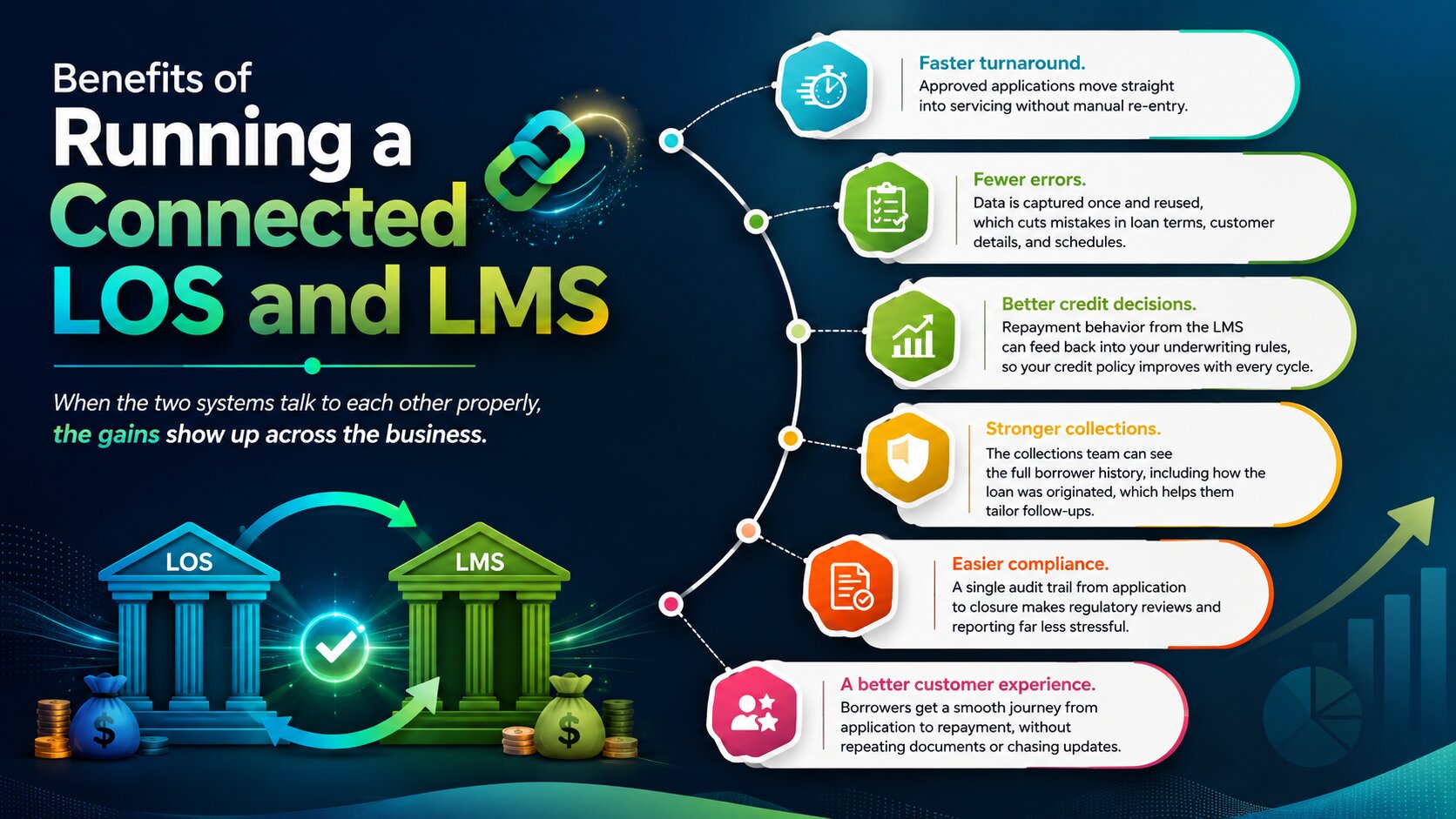
When the two systems talk to each other properly, the gains show up across the business.
Faster turnaround. Approved applications move straight into servicing without manual re-entry.
Fewer errors. Data is captured once and reused, which cuts mistakes in loan terms, customer details, and schedules.
Better credit decisions. Repayment behavior from the LMS can feed back into your underwriting rules, so your credit policy improves with every cycle.
Stronger collections. The collections team can see the full borrower history, including how the loan was originated, which helps them tailor follow-ups.
Easier compliance. A single audit trail from application to closure makes regulatory reviews and reporting far less stressful.
A better customer experience. Borrowers get a smooth journey from application to repayment, without repeating documents or chasing updates.
What about RBI Compliance?
This is where the LOS vs LMS for NBFCs conversation gets serious. RBI’s digital lending guidelines place clear expectations on NBFCs around transparency, disclosures, data handling, and grievance redressal.
Both systems play a part. The LOS needs to support clear loan terms, consent capture, and proper disclosures at the time of application, such as the Key Fact Statement. The LMS needs to maintain accurate records, apply charges correctly, and generate the reporting regulators expect.
If your systems are disconnected, proving a clean audit trail from sanction to closure gets harder. That’s one of the strongest practical arguments for tight integration. Always check that a vendor can explain, in plain language, how its product supports current RBI requirements and how quickly it rolls out updates.
What Does It Cost to Have Both?
- Pricing varies widely by vendor, volume, and scope, so treat any figure as a rough guide. In general:
- Small NBFCs can find cloud-based LOS and LMS options on a subscription basis, often starting in the tens of thousands of rupees per month.
- Mid-sized lenders with multiple products and integrations typically spend noticeably more, especially once bureau, eKYC, and eSign usage charges are added.
- Enterprise and custom builds can run into lakhs or crores, with implementation and annual maintenance on top.
Whatever the headline price, ask for an itemized quote that separates software fees, implementation, integrations, third-party API costs, and support. Integrated platforms can sometimes work out cheaper overall than two standalone products plus custom integration work.
Common Mistakes NBFCs Make When Choosing
Buying an LOS and ignoring the LMS. A beautiful application journey means little if you’re servicing and collections run on spreadsheets.
Underestimating integration effort. “Integrates with everything” in a brochure rarely means “works out of the box” in reality. Ask for live examples.
Choosing on price alone. The cheapest option often lacks the flexibility you’ll need in two years.
Skipping the scalability check. A system that handles 5,000 loans may struggle at 50,000. Ask about performance at higher volumes.
Ignoring data ownership. Make sure you can export your data in usable formats if you ever switch providers.
Forgetting your own team. The best software fails if your credit, operations, and collections staff aren’t trained and bought in.
How to Decide: A Simple Checklist
Before you shortlist vendors, answer these questions honestly:
- How many loans do we disburse monthly, and how fast do we expect that to grow?
- How many loan products do we offer, now and in the next two years?
- Is origination our bottleneck, or is it servicing and collections?
- Do we need co-lending, partner APIs, or app-based journeys?
- What integrations are must-haves (bureaus, eKYC, NACH, payment gateways)?
- How much IT capacity do we have in-house?
- What does our compliance team need to see in reports and audit trails?
Your answers will quickly show whether you need an LMS only, a full LOS + LMS stack, or an end-to-end platform.
Final Thoughts: LOS vs LMS Isn’t an Either/Or Decision
The LOS vs LMS for NBFCs question sounds like a choice, but for most NBFCs it’s really a question of timing and integration. The LOS helps you win and approve customers quickly. The LMS helps you serve, collect from, and report on them accurately. Run one without the other, and you’ll feel the gap sooner than you expect.
If you’re just starting out, begin with the system that solves your most urgent pain point, usually the LMS, and plan your path to a connected stack. If you’re already growing, look seriously at an integrated or unified platform so your data, workflows, and compliance trail stay in one place.
Whichever route you choose, insist on live demos with your own use cases, itemised pricing, and clear answers on RBI compliance. The right lending stack won’t just save you time. It will quietly improve your approvals, your collections, and your portfolio quality for years.
Frequently Asked Questions (FAQs)
1. What is the main difference between LOS and LMS?
A LOS handles the pre-disbursement stage: application, KYC, underwriting, and approval. An LMS handles the post-disbursement stage: repayments, collections, accounting, and loan closure.
2. Can an NBFC run on an LMS alone?
Yes, especially if volumes are low and origination is mostly manual. As you scale or add products, an LOS becomes increasingly valuable for speed and consistency.
3. Is a unified platform better than separate LOS and LMS products?
For many small and mid-sized NBFCs, yes. A unified platform reduces integration issues and keeps data consistent. Larger lenders with unique requirements sometimes prefer best-of-breed systems.
4. Does an LOS help with RBI compliance?
It does. A good LOS captures consent, disclosures, and KYC records at the point of application, which supports RBI’s digital lending expectations.
5. How long does it take to implement an LOS and LMS?
Cloud-based platforms can often go live in a few weeks to a few months. Enterprise or custom deployments may take six months or longer.
6. Can I add an LOS later if I start with an LMS?
Yes, provided your LMS offers open APIs or your vendor has a compatible LOS. Confirm this before you buy.