If you run an NBFC, you’ve probably had this experience. You ask three vendors for a quote and get three wildly different numbers: one says ₹40,000 a month, another says ₹35 lakh upfront, and a third won’t give a figure until you “book a demo”.
That’s frustrating, and it’s why so many lenders struggle to budget properly. The loan management software cost in India isn’t a single price tag. It depends on how you lend, how fast you’re growing, and how much of the lending lifecycle you want to automate.
This guide explains what you can expect to pay in 2026, what drives the price, and where the hidden costs tend to sit, so you can walk into vendor conversations with clear numbers.
What is Loan Management Software, and Why Do NBFCs Need It?
A loan management system (LMS) is the software backbone of a lending business. It handles everything from the moment a borrower applies to the day the loan is closed:
- Loan origination and application processing
- KYC and credit assessment
- Underwriting and approval workflows
- Disbursement
- EMI scheduling and collections
- Repayment tracking and reconciliation
- Reporting, MIS, and regulatory filings
Years ago, many small NBFCs got by with spreadsheets and a basic accounting package. That’s no longer realistic. With RBI’s tightening digital lending norms, growing borrower expectations, and thinner margins, manual operations are expensive in their own way: more errors, slower turnaround, and higher compliance risk.
So the question isn’t really whether to invest in an LMS. It’s how much to spend and on what.
Average Loan Management Software Cost in India (2026 Overview)
Prices vary a lot by vendor and scope, but here are the typical ranges NBFCs see in the Indian market. Treat these as indicative estimates and confirm them with vendors, since pricing shifts quickly.
| Software Type | Typical Cost Range | Best For |
| Basic cloud/SaaS LMS | ₹15,000 – ₹75,000 per month | Small NBFCs, startups, microfinance lenders |
| Mid-tier SaaS LMS with LOS | ₹75,000 – ₹3,00,000 per month | Growing NBFCs with multiple loan products |
| Enterprise / licensed LMS | ₹15 lakh – ₹75 lakh upfront + annual fees | Large NBFCs, HFCs, multi-branch lenders |
| Fully custom-built LMS | ₹30 lakh – ₹1.5 crore+ | Lenders with unique products or complex workflows |
In short, a small NBFC can start with a capable system for under ₹1 lakh a month, while a large lender with complex needs can spend well into crores over a few years.
The Main Pricing Models Explained
Before comparing quotes, understand how vendors charge. The model often matters more than the headline number.
1. Subscription (SaaS) Pricing
You pay a recurring monthly or annual fee, usually based on the number of users, active loan accounts, or feature tier. This is the most popular model for small and mid-sized NBFCs because it keeps upfront costs low and includes hosting, updates, and support.
Pros: Low entry cost, quick go-live, automatic updates.
Cons: Costs rise as you scale, and you’re dependent on the vendor.
2. Per-Loan or Per-Transaction Pricing
Some vendors charge a small fee per active loan account per month, or per disbursement or collection transaction. Typically this works out to a few rupees to a few tens of rupees per account, depending on volume and modules.
Pros: You pay in proportion to your business. Good for lenders with seasonal or unpredictable volumes.
Cons: Costs can balloon if your loan book grows quickly. Always model this against your 3-year projection.
3. One-Time Licence Fee
Here you pay a large upfront amount to license the software, plus an annual maintenance contract (AMC), usually 15–20% of the licence value.
Pros: Predictable long-term cost, more control, often on-premise deployment.
Cons: High capital outlay, slower implementation, and upgrades may cost extra.
4. Custom Development
You hire a development firm to build an LMS from scratch for your exact workflows. It’s the most expensive route and takes the longest, often 8–18 months, but it gives you complete flexibility.
Pros: Built around your process, full ownership.
Cons: High cost, long timelines, ongoing maintenance burden.
7 Factors That Drive Loan Management Software Cost in India
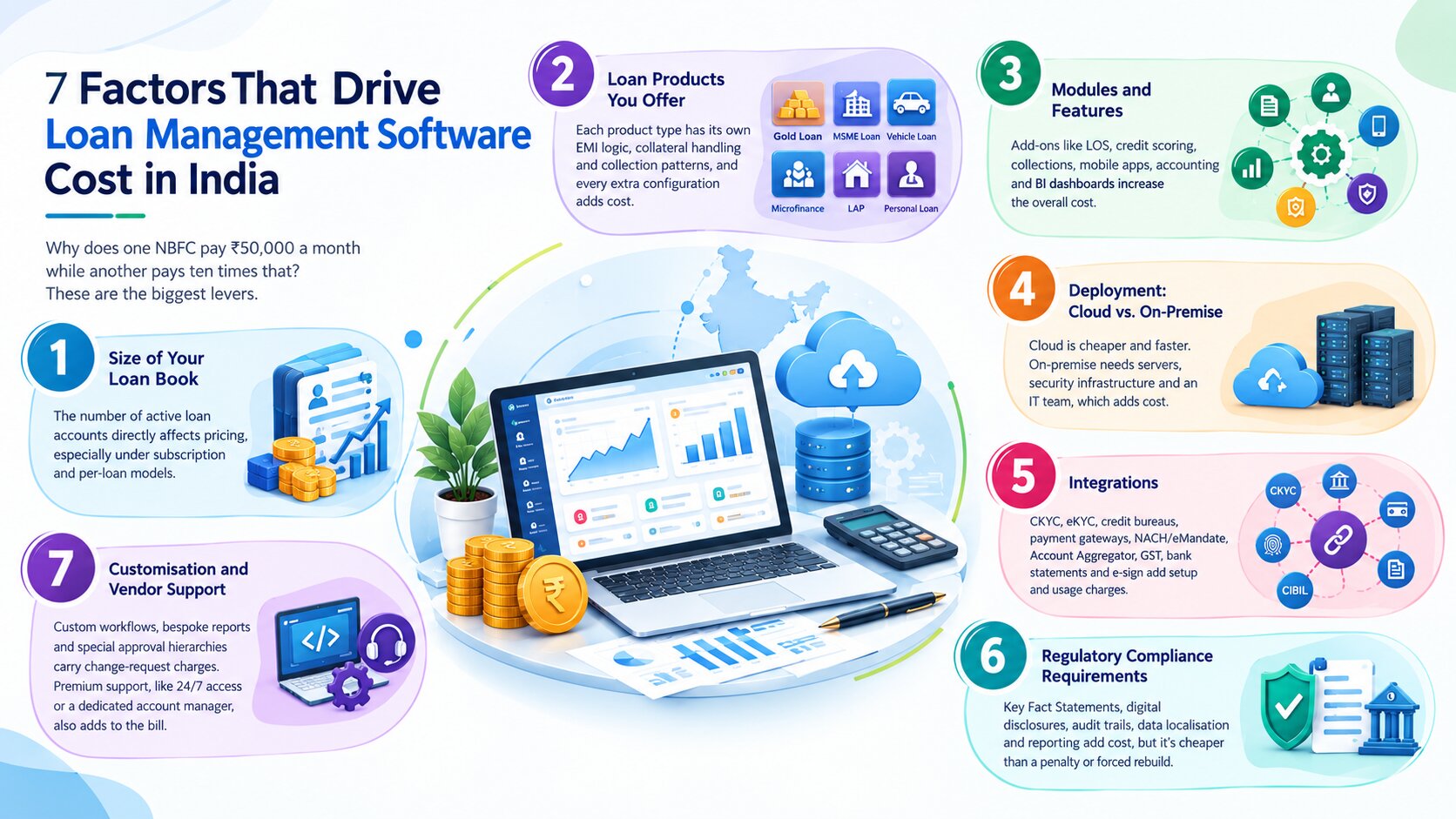
Why does one NBFC pay ₹50,000 a month while another pays ten times that? These are the biggest levers.
1. Size of Your Loan Book
The number of active loan accounts directly affects pricing, especially under subscription and per-loan models. A lender managing 2,000 loans has very different infrastructure needs from one managing 2 lakh.
2. Loan Products You Offer
A single product, like a personal loan, is simpler to configure than a mix of gold loans, MSME loans, vehicle finance, microfinance, and LAP. Each product type has its own EMI logic, collateral handling, and collection patterns, and every extra configuration adds cost.
3. Modules and Features
The core LMS is only one piece. Add-ons are where budgets stretch:
- Loan origination system (LOS)
- Credit scoring and underwriting engine
- Collections and recovery module
- Co-lending and partnership management
- Customer and agent mobile apps
- Accounting and general ledger
- Business intelligence dashboards
4. Deployment: Cloud vs. On-Premise
Cloud-based systems are cheaper to start with and quicker to deploy. On-premise deployments need servers, security infrastructure, and an IT team, which adds meaningful cost, though some lenders still prefer it for data control.
5. Integrations
Modern lending runs on integrations. Think CKYC, Aadhaar-based eKYC, credit bureaus such as CIBIL, Experian, Equifax, and CRIF High Mark, payment gateways, NACH/eMandate, Account Aggregator, GST and bank statement analyzers, and e-sign. Each integration may carry a setup fee, usage charges, or both.
6. Regulatory Compliance Requirements
RBI’s regulatory expectations keep evolving. In 2026, NBFCs need software that supports Key Fact Statements, transparent digital lending disclosures, audit trails, data localisation, and reporting obligations tied to their scale-based regulatory layer. A system that bakes compliance in costs more than a generic tool, but it’s usually cheaper than a penalty or a forced rebuild.
7. Customisation and Vendor Support
Standard, out-of-the-box software is cheaper. The moment you ask for custom workflows, bespoke reports, or special approval hierarchies, expect change-request charges. Premium support, such as 24/7 availability or a dedicated account manager, also adds to the bill.
The Hidden Costs Most NBFCs Overlook
The sticker price is rarely the whole story. When you calculate the true loan management software cost in India, include these items.
Implementation and onboarding. Many vendors charge a separate one-time fee, often ₹1 lakh to ₹10 lakh or more, for setup, configuration, and go-live support.
Data migration. Moving your existing loan data from spreadsheets or legacy systems takes planning and cleanup. Poor data quality can stretch timelines and costs.
Training. Your credit, operations, and collections teams all need to learn the system. Some vendors include training, while others bill per session.
Third-party API charges. Bureau pulls, eKYC checks, SMS, WhatsApp notifications, and eSign all cost money per use. At scale, these can rival your software subscription.
Customisation and change requests. Your product will evolve. New loan schemes, new reports, or a policy change from the regulator often mean paid modifications.
Annual maintenance and upgrades. For licensed software, AMC is a recurring line item. For SaaS, check whether major upgrades are included or billed separately.
Exit costs. What happens if you switch vendors in three years? Ask upfront about data export formats and any termination fees. Getting locked in is an expensive mistake.
Estimated Budget by NBFC Type
To make this practical, here’s how budgets often look for different kinds of lenders.
Early-stage NBFC or fintech lender (up to a few thousand loans): A SaaS LMS with basic origination and collections is usually enough. Budget roughly ₹25,000–₹1 lakh per month, plus ₹1–3 lakh for implementation.
Growing NBFC (tens of thousands of loans, multiple products): You’ll likely need a fuller LOS + LMS suite with collections, co-lending, and deeper integrations. Budget around ₹1–4 lakh per month, with implementation in the ₹5–15 lakh range.
Large NBFC or HFC (lakhs of loans, multiple branches): Enterprise-grade platforms, often with custom configuration, start in the tens of lakhs and can reach crores over the system’s life, including AMC and integrations.
Again, these are directional figures. Your actual quote will depend on your exact requirements.
SaaS vs. Custom-Built LMS: Which is More Cost-Effective?
For most NBFCs, SaaS wins on cost and speed. You can be live in weeks rather than a year, the vendor handles hosting and security, and regulatory updates are rolled out for you.
Custom builds make sense in a narrower set of cases: you run a genuinely differentiated lending model, you have large, stable volumes that justify the investment, or you have an in-house tech team to maintain the platform. Even then, many lenders choose a configurable platform and customise on top of it rather than starting from zero.
A useful rule of thumb: if you can meet 80% of your needs with an existing product, buy. Build only when the missing 20% is your competitive edge.
How to Choose the Right LMS Without Overspending
Price matters, but the cheapest option often becomes the most expensive one. Keep these points in mind.
Start with your requirements, not vendor demo. Write down your products, workflows, volumes, and must-have integrations first. It stops vendors from upselling modules you don’t need.
Ask for a detailed, itemised quote. Insist on separate lines for licence or subscription, implementation, integrations, support, and customisation.
Check RBI readiness. The vendor should clearly explain how their system supports current digital lending guidelines and how quickly they ship regulatory updates.
Test scalability. Ask how pricing and performance change if your book grows 5x. Today’s bargain shouldn’t become tomorrow’s bottleneck.
Speak to existing NBFC clients. References from lenders of similar size tell you more than any brochure.
Negotiate the contract terms. Look at lock-in periods, price escalation clauses, SLAs, and data ownership. A 5–10% annual price hike clause can quietly add up.
Pilot before committing. If possible, run a limited rollout on one product or branch before going all-in.
Is Loan Management Software Worth the Investment?
Absolutely, and the numbers usually back it up. A good LMS cuts turnaround time on loan approvals, reduces manual errors, improves collection efficiency, and gives you real-time visibility into portfolio health, including early signs of rising NPAs. It also makes audits and regulatory reporting far less painful.
Think of the software cost not as an expense but as infrastructure. A lender who disburses faster, collects better, and stays compliant will almost always out-earn one patching things together with spreadsheets.
Final Thoughts
The loan management software cost in India in 2026 can range from a few thousand rupees a month to a crore-plus investment, and where you land depends on your scale, products, integrations, and compliance needs. For most NBFCs, a cloud-based SaaS LMS offers the best balance of cost, speed, and flexibility, with room to upgrade as you grow.
Whatever you choose, look beyond the headline price. Factor in implementation, integrations, support, and future scaling, and get everything in writing. A transparent, well-scoped contract will save you far more than a steep discount ever could.
Ready to budget for your own system? List out your loan products, expected volumes, and must-have integrations, then request itemised quotes from two or three vendors. You’ll quickly see which ones are pricing honestly.
Frequently Asked Questions (FAQs)
1. What is the average loan management software cost in India for a small NBFC?
Small NBFCs can typically find cloud-based systems starting from around ₹15,000 to ₹75,000 per month, plus a one-time implementation fee. Exact pricing depends on users, loan volume, and modules.
2. Is SaaS or on-premise loan management software cheaper?
SaaS is cheaper upfront because there’s no hardware or large licence fee. Over many years, on-premise licensing can work out competitive for very large lenders, but it demands more IT investment.
3. What hidden costs should NBFCs expect?
Common extras include implementation fees, data migration, training, third-party API charges (bureau, eKYC, SMS), customisation, annual maintenance, and exit or data-export fees.
4. How long does it take to implement an LMS?
SaaS platforms can go live in a few weeks to three months. Enterprise or custom systems often take six to eighteen months.
5. Does the software need to be RBI-compliant?
Yes. Your LMS should support RBI’s digital lending requirements, including transparent disclosures, audit trails, secure data handling, and regulatory reporting.
6. Can I switch loan management software later?
Yes, but migration can be complex and costly. Confirm data ownership, export formats, and contract exit terms before you sign.